
JINAN TRUCKMAN AUTOMOBILE CO.,LTD


TRUCKMAN International Sales Center
- WhatsApp: +86 18615693883

- E-mail: contact@truckmanauto.com
SALES DEPARTMENT 1
Contact Person: Eric GAO
- WhatsApp: +86 15665736726

E-mail: eric@truckmanauto.com
Contact Person: Angela WANG
- WhatsApp: +86 19153136362

E-mail: angela@truckmanauto.com
Contact Person: Luna LIU
- WhatsApp: +86 19153138337

E-mail: luna@truckmanauto.com
SALES DEPARTMENT 2
Contact Person: Tyne GUO
- WhatsApp: +86 15330633674

E-mail: tyne@truckmanauto.com
Contact Person: Scott YANG
- WhatsApp: +86 17615404503

E-mail: scott@truckmanauto.com
A Complete Guide to Selecting Mining Excavators in Africa
Introduction
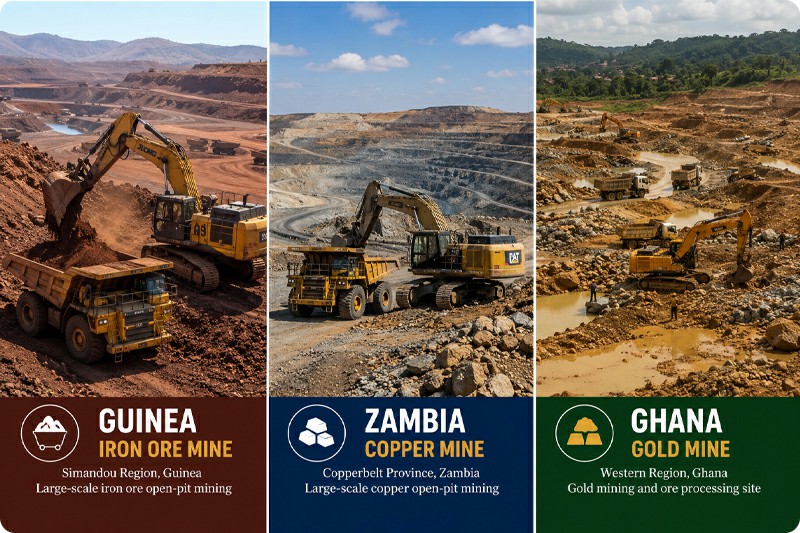
For mining companies in Africa, selecting the right mining excavator is a critical decision. Iron ore mines in Guinea , copper mines in Zambia and gold mines in Ghana, the equipment specifications, configuration plans, and operational performance vary across different engineering projects.
Industry data shows that, China's construction machinery exports to Africa reached 3.879 billion US dollars from January to April 2026, among these, exports of excavators to Africa rose 54% year-over-year, South Africa, Nigeria, and Guinea all rank among the top 10 countries in terms of cumulative export value of Chinese excavators. Approximately 75% of the demand for excavators in Africa comes from the mining of non-ferrous and precious metals such as copper, gold, and lithium. In countries such as Guinea (iron ore/bauxite), Mali (lithium), and Nigeria (iron ore/rare earth minerals), the growth rate in demand for excavators has exceeded 100%.
Choosing the right mining excavator based on sound principles directly impacts a project’s return on investment and long-term operational efficiency. This article provides a comprehensive guide to purchasing mining excavators in Africa.
Why is excavator selection crucial for mining operations in Africa?
Mining sites in Africa are generally characterized by extreme weather conditions, poor road conditions, inadequate maintenance support, and long lead times for spare parts. Wrong equipment selection will directly result in huge economic losses. The following points need to be focused on:
Fuel cost
Diesel costs typically account for 20% to 40% of a mine's total operating costs. For a 100-ton-class excavator, fuel consumption can account for up to 40% of operating costs. Fuel efficiency has therefore become one of the key metrics of concern for investors in Africa's mining sector.
Downtime Losses
In remote African mining areas, spare parts supply is difficult, equipment failures can easily lead to prolonged production shutdowns.
Maintenance
Maintenance infrastructure in African mining areas is inadequate, choosing models that are easy to maintain and have a reliable supply of replacement parts can reduce long-term operating costs.
Production Efficiency
The operational efficiency of an excavator directly affects output, selecting the correct tonnage, hydraulics, vibration and other configurations for an excavator can bring out its maximum production capacity.
Severe Weather
Extreme climatic conditions in African mining areas include year-round high temperatures, heavy dust, and muddy roads during the rainy season, which necessitates the selection of excavators with excellent heat resistance, dust protection, and heat dissipation capabilities.
Identify the Requirements for Mining Projects
Mineral Type
Different ores have different digging resistances, which is very important for the selection of excavators.
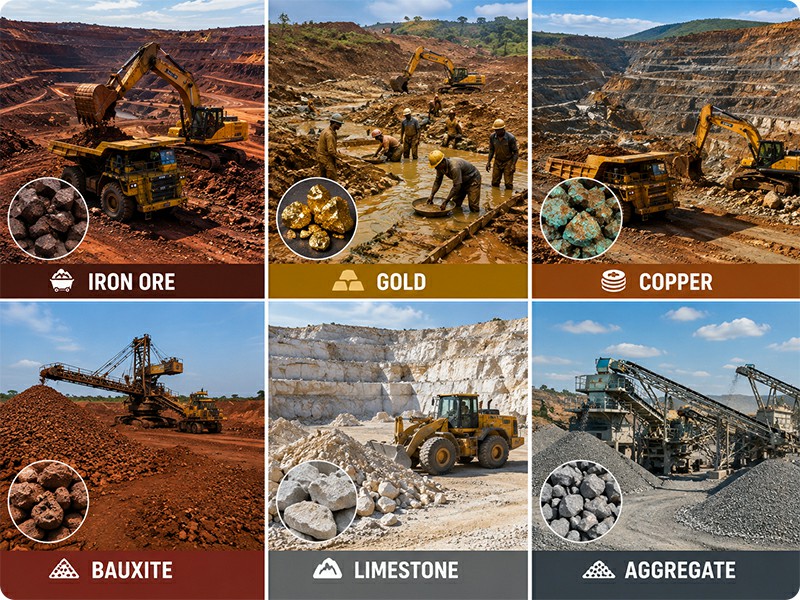
● Iron Ore (Simandou, Guinea)
Iron ore is dense and hard, placing extremely high demands on the bucket strength, digging force, and undercarriage stability of excavators.
● Gold Mines (Ghana, Mali)
Gold mining typically involves hard rock excavation and ore stripping, which requires excavators to have high breaking force and good hydraulic system response.
● Copper mines (Zambia, Democratic Republic of the Congo)
Copper mines are often located in deep deposits, requiring heavy-duty excavators for large-scale stripping and loading operations.
● Bauxite (Guinea)
Bauxite is relatively soft, but it places high demands on the wear resistance of the buckets and the equipment’s ability to operate continuously.
● Limestone Mine
For materials of medium hardness, 30-ton-class excavators are usually competent for the job.
● Stone
Stone mining imposes high requirements on the wear resistance of buckets and the cyclic operation efficiency of equipment.
Material Hardness
For soft materials such as clay and weathered rock, larger-capacity buckets can be used to improve efficiency.
For hard rock such as granite and iron ore, a rock bucket and a reinforced boom are required, at the same time, higher hydraulic system pressure is required to provide sufficient digging force.
Working Environment
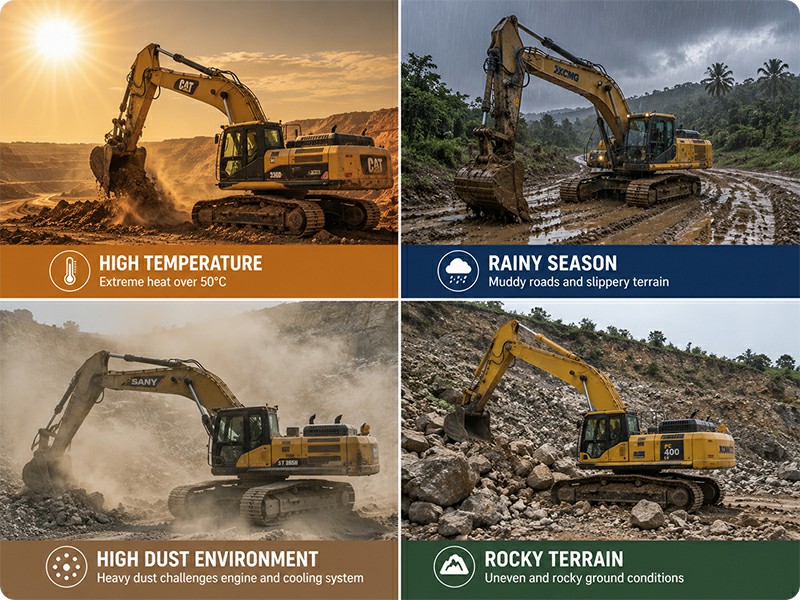
● High Temperature
The surface temperature at many mining areas in Africa can exceed 50°C in summer.
Excavators must be equipped with an efficient cooling system and use high-temperature-resistant hydraulic fluid and lubricating oil.
● Rainy Season
The rainy season in regions such as West Africa will turn mining area roads extremely muddy, crawler excavators have better maneuverability in muddy terrain than wheeled excavators.
● Soil and Dust
High-dust environments pose a severe challenge to engine air intake systems, radiators and hydraulic systems. Enhanced air filters and dust-proof seals are essential configurations.
● Rocky Terrain
Rugged, uneven rocky terrain requires excavators to have a sturdy undercarriage and good stability.
Working Hours
The operating shift directly determines the selection of engine, cooling system and fuel tank specifications.
● 8 hours / day
A standard engine and conventional cooling are sufficient.
● 12 hours / day
Common in African mines, requiring enhanced heat dissipation and wear-resistant engine components.
● 24-hour continuous operation
For continuous operation, it is essential to use an industrial heavy-duty engine, a larger fuel tank, and a fully reinforced cooling system.
How to Choose a Mining Excavator with the Right Tonnage?
When selecting an excavator's tonnage, it is necessary to comprehensively consider the scale of the mine, the type of material, and the supporting transportation equipment.
The following is a reference list for common tonnage selection in African mining areas:
| Excavator Tonnage | Applicable Scenarios | Compatible Minerals |
| 20-ton class | Small, light-duty quarries; topsoil stripping | Construction Aggregates, Loose Surface Sand and Gravel |
| 30-ton class | Surface mining at medium-sized limestone mines and small-scale gold mines | Limestone, small-scale open-pit gold mines |
| 40-ton class | Medium-sized iron ore mining areas; small- and medium-sized bauxite mines | Iron ore, medium-sized bauxite deposits |
| 50-ton class | Large-scale open-pit copper-gold mine, large-scale topsoil removal | Copper mines, large-scale gold mines |
| 70-ton class and above | Ultra-large-scale open-pit heavy-duty mines | Large-scale mining of high-hardness iron ore and large bauxite deposits |
Analysis of Models of Various Tonnages:
20-ton Class Excavator
low investment and operating costs, easy transportation, suitable for newly‑established small-scale mine contractors.
Recommended Models:XCMG XE200GA, XCMG XE215C, CAT 320GX, etc.
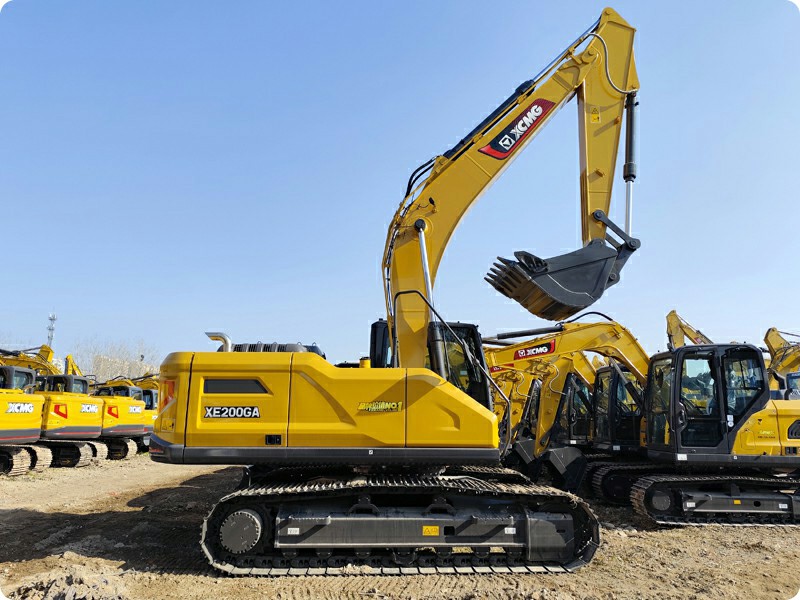 XCMG XE200GA XCMG XE200GA |
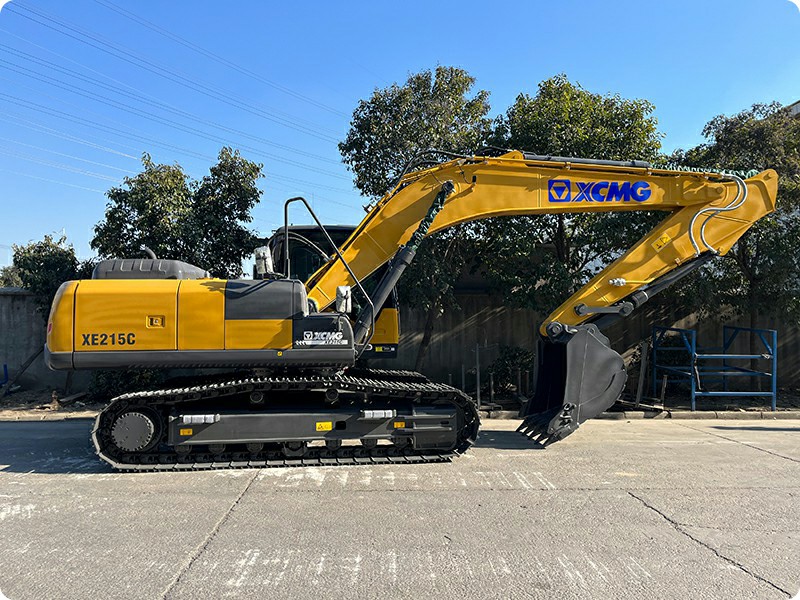 XCMG XE215C XCMG XE215C |
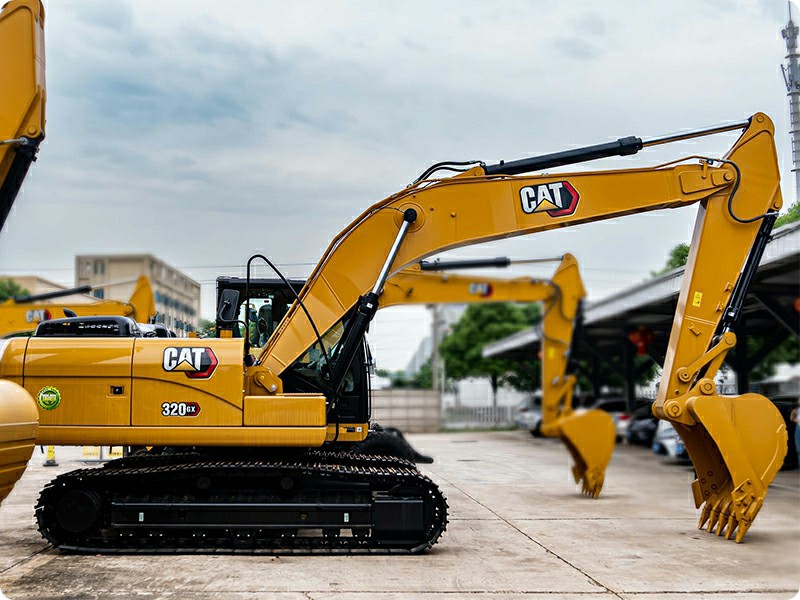 CAT 320GX CAT 320GX |
30-ton Class Excavator
Offering a balance of power and flexibility, with moderate maintenance costs, these machines are the mainstream choice for small and medium-sized limestone and small gold mines in Africa. Taking the 33--ton model as an example, it has performed exceptionally well in West African gold mines, operating 18 to 20 hours a day.
Recommended Models:XCMG XE335GK, CAT 336, HYUNDAI HX340HD, etc.
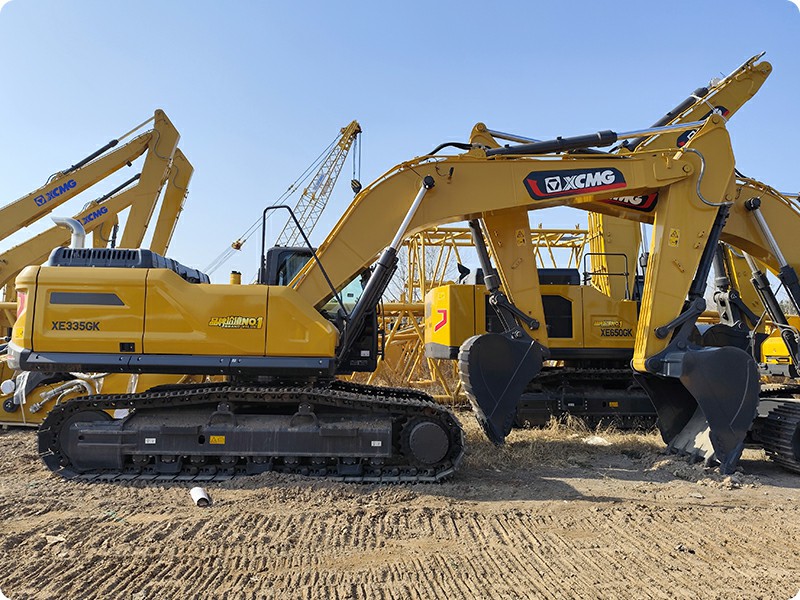 XCMG XE335GK XCMG XE335GK |
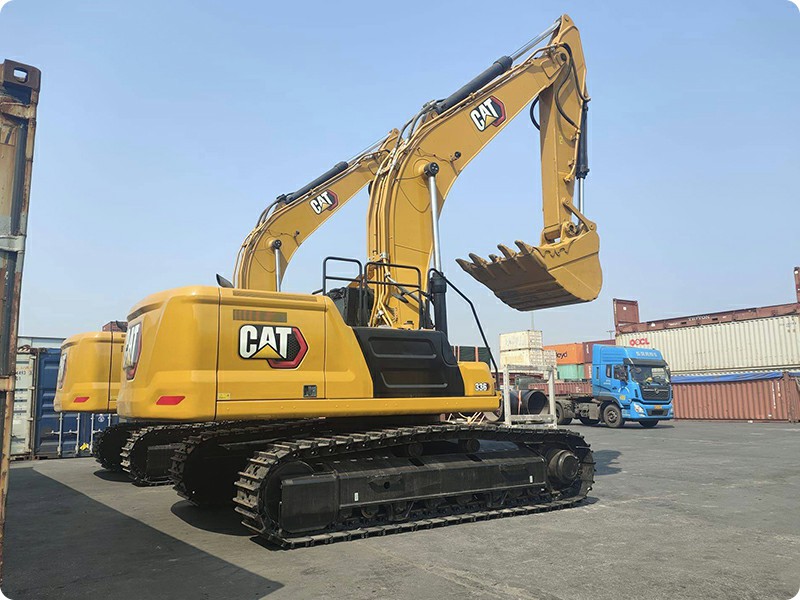 CAT 336 CAT 336 |
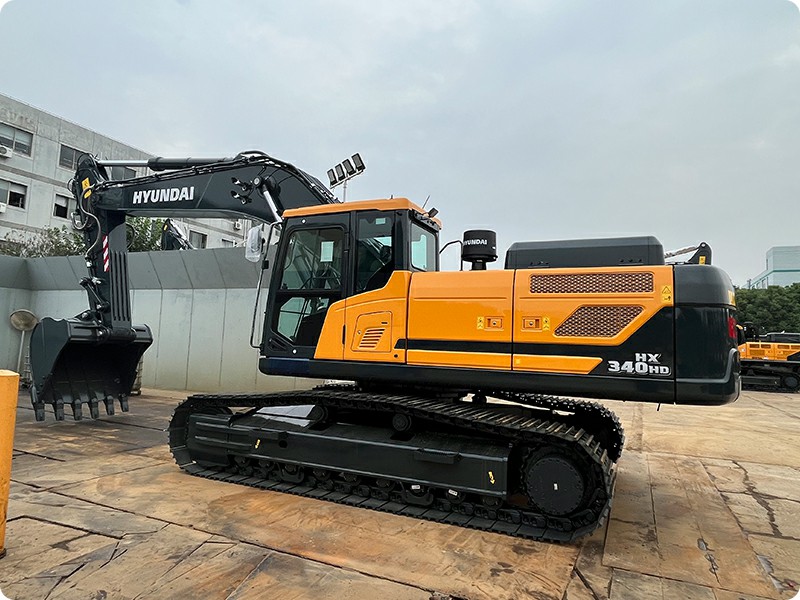 HYUNDAI HX340HD HYUNDAI HX340HD |
40-ton Class Excavator
An ideal choice for iron ore and hard rock mining, a popular model for iron ore mines in Guinea, featuring ample power, moderate fuel consumption, and suitable for continuous mining in medium-sized mines.
Recommended Models:XCMG XE490DK, HYUNDAI HX400HD, etc.
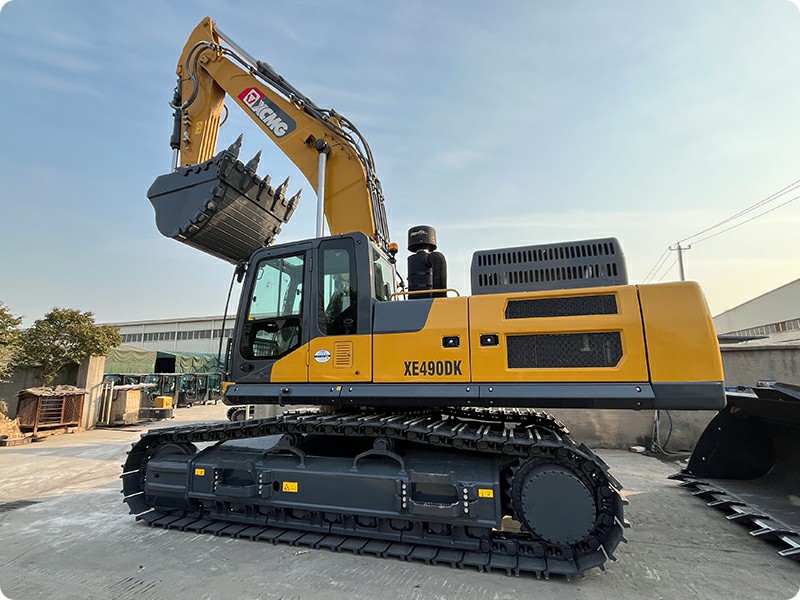 XCMG XE490DK XCMG XE490DK |
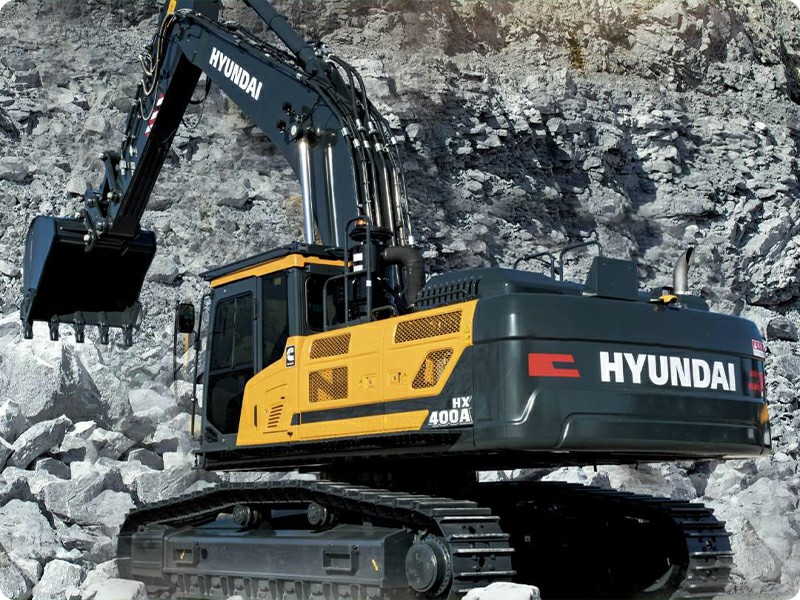 HYUNDAI HX400HD HYUNDAI HX400HD |
50-ton Class Excavator
The workhorse model for large-scale open-pit mines, suitable for high-intensity continuous operation. It is the primary model used at copper mines in Zambia and large-scale gold mines in Ghana. With its large bucket capacity and compatibility with heavy-duty mining trucks, it offers higher loading efficiency.
Recommended Models:CAT 350, XCMG XE500DK, etc.
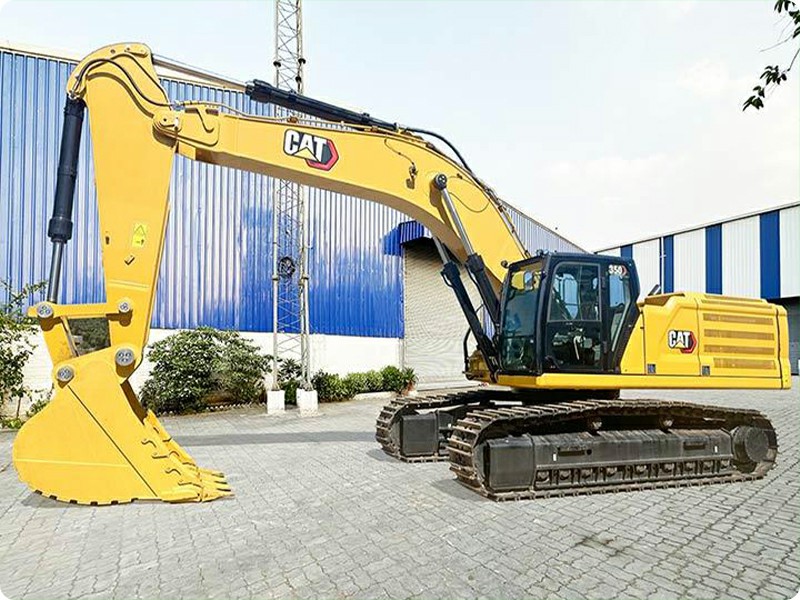 CAT 350 CAT 350 |
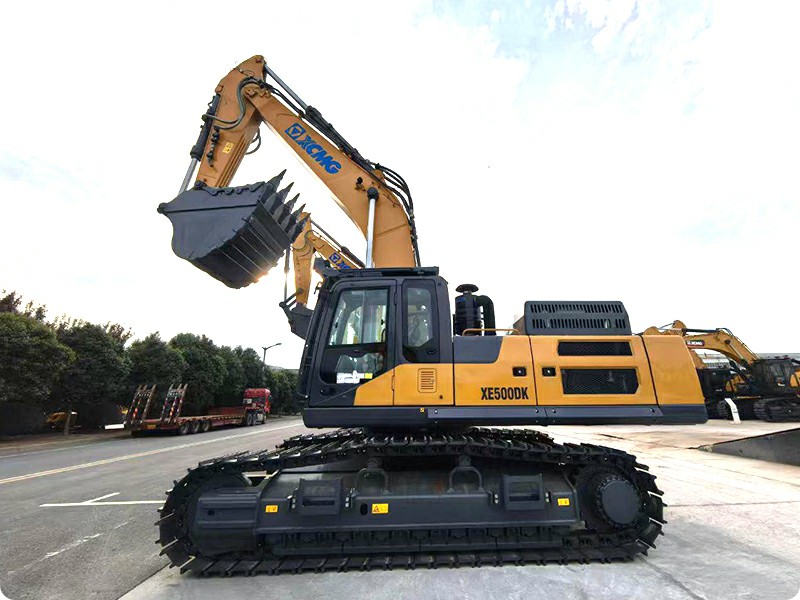 XCMG XE500DK XCMG XE500DK |
Heavy-duty Excavators of 70-ton Class and Above
Selection for super-large mines, featuring huge stripping volume, high-power adaptability for bulk hard-rock mining. It is suitable for large-scale stripping and loading operations in world-class mines, with high investment and high requirements for maintenance capabilities.
Crawler Excavator or Wheeled Excavator?
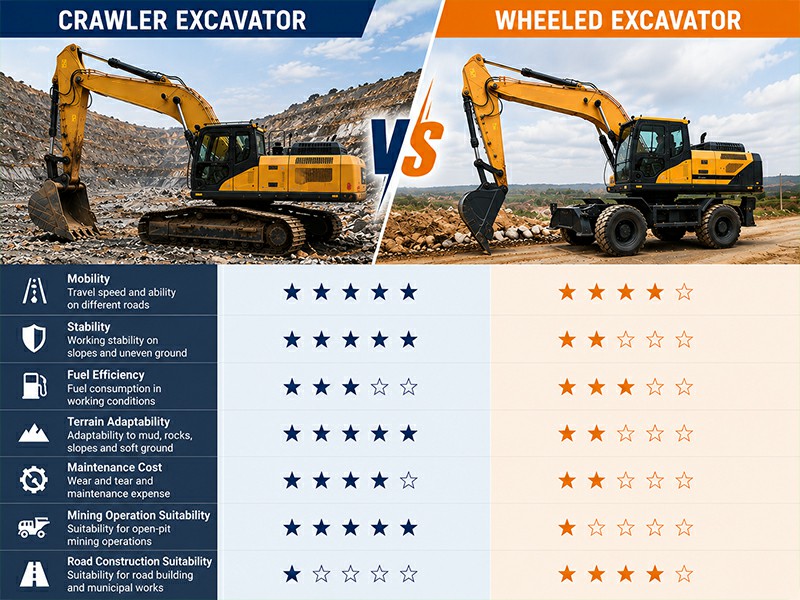
This is one of the most common decisions faced by mining investors in Africa. Both have their pros and cons, but for mining projects in Africa, crawler excavators are more suitable.
Comparison Table:
| Crawler Excavator | Wheeled Excavator | |
| Mobility | It drives slowly on paved roads but has excellent off-road capability. | Road transport is fast, but it has poor maneuverability in complex mining areas. |
| Operational Stability | The chassis is sturdy and provides excellent traction on muddy and rocky slopes. | The vehicle is lightweight, so it can easily skid and roll over on uneven, pitted terrain. |
| Fuel Consumption | Fuel consumption is slightly higher under heavy-duty conditions, but performance remains stable during prolonged operation. | Short-haul transport saves fuel, while heavy-load excavation causes fuel consumption to skyrocket |
| Terrain Adaptation | Perfectly suited for muddy terrain, steep slopes, and rocky open-pit mines. | Suitable only for road construction on flat factory grounds and around mining areas. |
| Maintenance Costs | The track plates are wear-resistant, and chassis components are easy to replace. | Tires wear out extremely quickly in rocky mining areas, and replacement costs are high. |
| Mining Operation Suitability | The Top Choice for All Open-Pit Mining Operations. | Used solely as auxiliary equipment for mining road construction. |
| Road Construction Suitability | Long-distance road transport is inconvenient. | There are clear advantages to road construction as part of infrastructure development in both urban and rural areas. |
Mining sites in Africa typically feature unpaved roads, muddy conditions, rocky terrain, and steep slopes. Therefore, a tracked undercarriage provides greater stability, more traction, and lower ground pressure.
What Key Configurations Should Be Focused On For Mining Excavators In Africa?
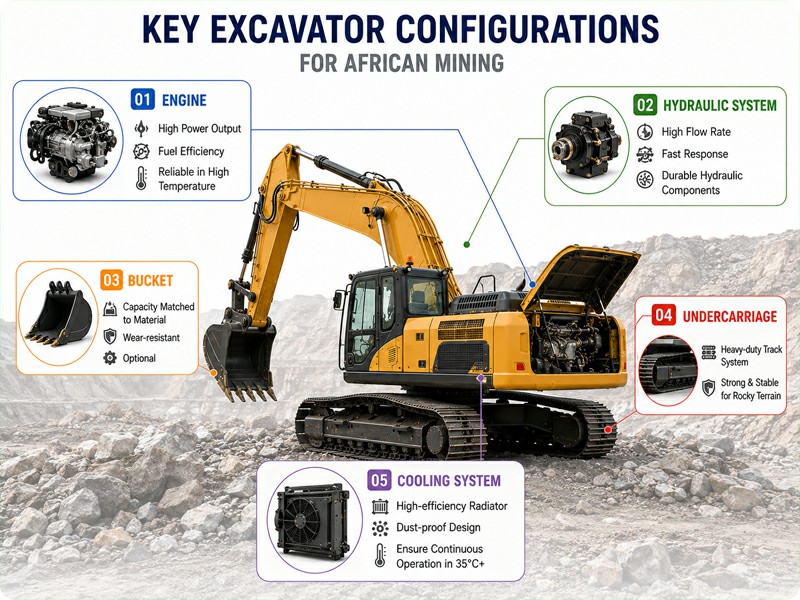
When selecting an excavator for mining sites in Africa, key specifications to consider include engine power, hydraulic system, bucket capacity, the undercarriage, and the cooling system.
Engine
For African mining sites with high temperatures and high altitudes, engines need to deliver high power output, stable operation under high-temperature and heavy-load conditions, and good fuel economy. However, we should not simply pursue the maximum horsepower; instead, we should match the equipment tonnage, working intensity and fuel cost.
Hydraulic System
The hydraulic system determines an excavator's digging force, operating speed, and work efficiency, it is recommended to select high-flow hydraulic systems and high-durability hydraulic components for African mines.
Bucket Capacity
The size of the bucket directly affects output, but bigger isn’t always better. The bucket’s capacity must be appropriately matched to the ore density, the excavator’s tonnage, and the truck’s capacity.
Undercarriage
The environment in African mining areas imposes high requirements on track systems. The thickness of track shoes, the quality of track rollers, and the strength of the slewing platform are extremely important. A wider and longer tracked undercarriage improves traction and stability on soft ground.
Cooling System
In many parts of Africa, temperatures exceed 35°C year-round. In such high-temperature environments, the efficiency of the cooling system directly determines the equipment’s ability to operate continuously. Therefore, mining equipment must be equipped with a high-efficiency cooling system and large-area radiators with dust-proof designs to prevent the engine from shutting down due to overheating.
How to Reduce Operating Costs
The purchase cost of mining excavators is only a portion of the total investment, long-term operating costs are the key factor in determining a project’s profitability. Regular maintenance, standardized operations and scientific daily inspections can effectively reduce operating costs.
Perform Preventive Maintenance
Perform regular maintenance, develop a scientific maintenance plan, and replace filters, lubricants, and wear-and-tear parts on schedule, avoid major overhauls caused by damage of large-scale components.
Operator Training
Skilled operators not only improve operational efficiency but also reduce equipment wear and fuel waste. Rough handling accelerates wear and tear on the hydraulic system and undercarriage, so professionally trained operators can extend the equipment’s service life.
Stock Up On Genuine Replacement Parts In Advance
Using genuine or high-quality parts ensures optimal equipment performance and longevity, and helps prevent secondary failures caused by substandard parts.
Routine Inspections
Establish a daily inspection system to systematically check each item, including track tension, hydraulic oil level, the cooling system, and dust filters to promptly identify and address minor issues, thereby preventing minor malfunctions from escalating into major downtime.
Control Idle Duration
Long-time idling not only wastes fuel but also accelerates engine wear. It is recommended to turn off the engine promptly while waiting for loading and unloading. The automatic idle-stop function can be enabled to reduce fuel waste during non-operation periods.
Common Mistakes Made by African Mine Owners When Selecting Excavators
Based on our years of experience serving mining clients in Africa, we have summarized the following common purchasing misconceptions.
Choosing a Model with Insufficient Tonnage
Many customers choose smaller-tonnage excavators to save on initial costs, but this results in the excavators being unable to meet production capacity requirements. Furthermore, prolonged operation at full capacity accelerates equipment wear and tear.
Ignore The Supply Status Of Spare Parts
In remote mining areas in Africa, spare part supply is a critical issue, so we advise customers not to buy niche brands, before making a purchase, be sure to confirm the availability of spare parts in your area or verify that the dealer can supply excavator spare parts to avoid prolonged downtime in the event of equipment failure.
Look Only at The Price
Using price as the sole criterion for selection, without considering the total cost of ownership, low-priced equipment often poses risks in terms of durability, fuel efficiency, and after-sales service.
How Does TRUCKMAN Help African Customers Select Mining Equipment?
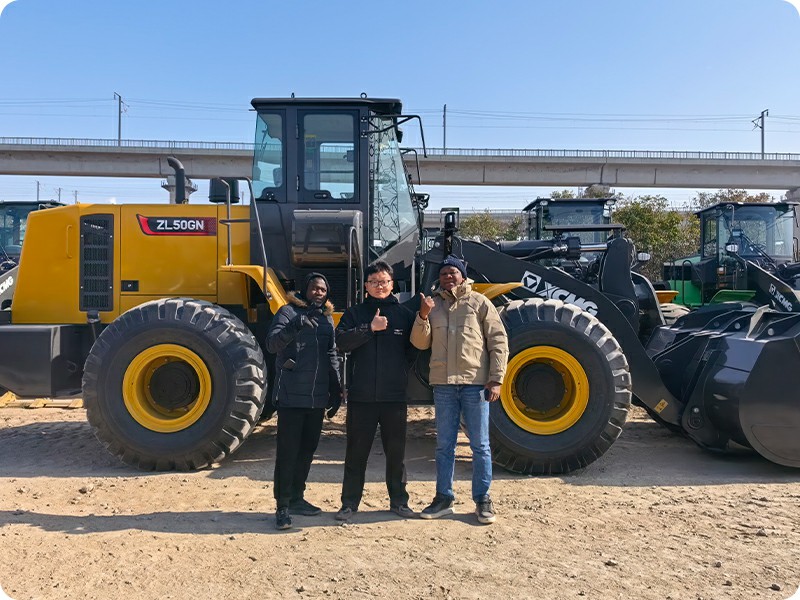
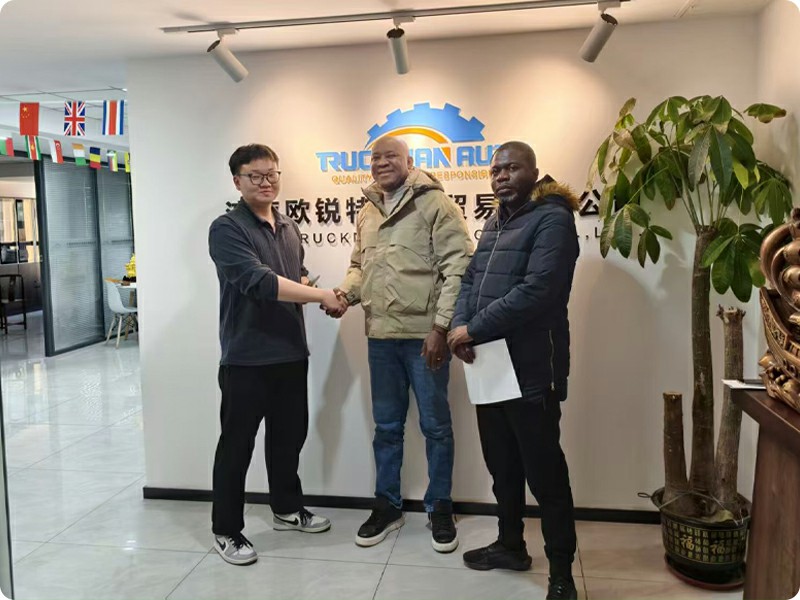
With years of export experience and a professional service team, TRUCKMAN has become a trusted partner for mining clients in Africa. TRUCKMAN not only offers a full range of excavators from well-known brands such as XCMG, SHANTUI, DEVELON, and CAT, but also provides comprehensive equipment solutions tailored to specific mining projects. The company has successfully served mining clients in multiple African countries, including Rwanda, Nigeria, and Ghana. From equipment selection consulting to spare parts supply, TRUCKMAN is committed to providing one-stop procurement solutions for African mining clients.
Our product range includes:
 Excavators Excavators |
 Wheel Loaders Wheel Loaders |
Bulldozers |
| Motor Graders |
Mining Dump Trucks |
Heavy Transport Vehicles |
For our mining clients in Africa, we can tailor our services based on:
 Mine Type Mine Type |
Annual production |
Road Conditions |
| Transportation Distance |
Investment Budget |
Recommend a suitable combination of equipment.
For example:
Mining Plan:
Excavator + Wheel Loader + Dump Truck
Develop a comprehensive mining and transportation solution.
Are you looking for a reliable mining excavator for your engineering project in Africa?
 |
|
| TRUCKMAN team can help you find the right model based on your mining conditions, budget, and production capacity requirements. | |
 |
 |
FAQ
1. What size excavator is best suited for mining operations?
This depends on the type of mine and production requirements:
Small and medium sized mines (limestone, quarries) generally adopt the 20 to 40-ton class; large scale metal mines (iron ore, copper ore) require models of 50-ton class and above. It is recommended to determine the specific tonnage based on the daily output target and the specifications of transport trucks.
2. How long can a mining excavator last?
With proper maintenance, it can typically operate for 10,000-20,000 operating hours or even longer.
3. What is the approximate fuel consumption of excavators in African mining areas?
- ● 20 metric tons: 12-18 L/hour;
- ● 30 metric tons: 18-25 L/hour;
- ● 40 metric tons: 26-35 L/hour;
- ● 50 metric tons: 35-48 L/hour;
- ● 70 metric tons or more: 50–70 L/hour.
4. Which brand of excavator offers better quality?
International brands such as CAT, KOMATSU, and VOLVO offer exceptional quality but come at a higher price;
Chinese brands such as XCMG, SANY, and ZOOMILON have significantly improved in quality in recent years and offer outstanding value for money, making them popular choices in the African market.


